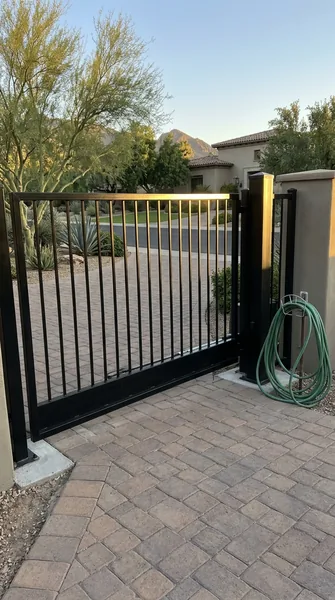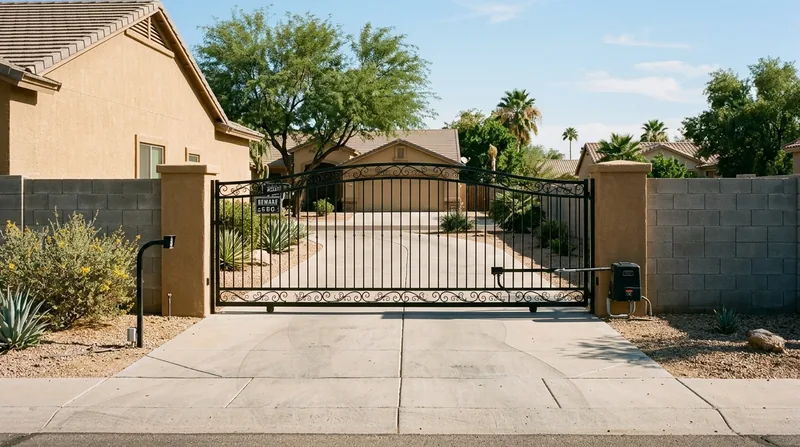




A driveway gate installation in Phoenix requires more than a standard gate contractor. Valley driveways sit on caliche hardpan, a cemented layer that demands heavy posts set deep and anchored with concrete to hold against monsoon microbursts that arrive without warning from June through September. The desert sun fades powder coating and splits untreated wood faster than humidity ever rots it, and a gate operator wired for reliable power through 120-degree summers is not a detail. We set posts below grade, align the gate for smooth swing or slide, and wire the opener so it works when you need it, not when the heat backs off.
Why Driveway Gates Matter in Phoenix's Desert Climate
Phoenix homeowners face a unique challenge: wind gusts that flatten standard fence runs, ground conditions that make post holes a labor-intensive job, and UV exposure that degrades hardware and finishes on a compressed schedule. A driveway gate that swings freely in January can bind by August if it is not set and maintained correctly. The monsoon season brings dust storms with sustained winds that test every hinge and operator, and the mild winter window from October through March is when most installations happen. Getting a gate right means understanding both the hardware and the ground, and that is what separates a functional gate from one that sticks, sags, or fails.
- We set posts below the caliche layer and anchor them in concrete to resist wind and settlement.
- We wire gate operators for consistent power through summer heat without nuisance shutdowns.
- We align swing gates and sliding gates for smooth operation and proper clearance from vehicles and structures.
- We use heavy-duty hardware rated for Arizona UV and desert temperature swings.
- We verify utility locates before digging and confirm all local permitting requirements with the city.
A properly installed gate is one you do not think about until it needs repair or adjustment.
Key info: Phoenix, Scottsdale, and Chandler all have different setback and height rules for driveway gates. Check with your local building department before design. Many master-planned communities in Gilbert, Peoria, and Anthem also require HOA approval for gate material and color. We verify requirements and pull permits where needed.
How We Install Automatic and Driveway Gates in Phoenix
Installation starts with a site visit to assess the driveway width, ground condition, utility lines, and any obstacles near the gate line. We call for a utility locate (Arizona 811 is required by law), mark the post locations, and break through caliche if needed. Posts are set below grade in concrete, and the gate frame is built and hung for alignment before the operator is wired and tested. Swing gates pivot on heavy hinges anchored to the post, while sliding gates ride a track and cantilever from the post. The operator is mounted, hardwired to a power source, and programmed for smooth open and close cycles.
- We conduct a free site visit and measure the driveway, identify utilities, and discuss swing versus sliding options.
- We call for a utility locate and mark all underground lines before digging post holes.
- We excavate post holes below the caliche layer and set posts in concrete for permanent anchorage.
- We build and hang the gate frame, check alignment, and adjust hinges or track for smooth operation.
- We mount the gate operator and hardwire it to a dedicated 110V circuit or existing power line.
- We test the gate under load, program open and close delays, and verify safety features before handoff.
The entire process typically takes one to two days depending on ground conditions and whether utilities are in the way.
Local example: A Queen Creek homeowner with a 16-foot-wide driveway needed a sliding gate to avoid swinging into a pool fence on the side. We set a cantilever post system, installed a 1/2-horsepower linear operator, and added a photo-eye safety sensor. Total time on site: one day. Gate has been running for three seasons without service.
Swing Gates Versus Sliding Gates: Which Works Best for Your Driveway
Swing gates hinge from a post and swing outward or inward depending on the driveway layout. They are simpler to install and repair, but they need clearance on one side and are slower to open. Sliding gates roll along a ground track or hang from an overhead rail and slide sideways, ideal for tight driveways or steep grades where a swing gate would catch. Both systems work in Phoenix, but the choice depends on your driveway width, available clearance, and whether the ground is level or sloped.
| Gate Type | How It Works | Best For |
|---|---|---|
| Swing Gate (Single or Dual Arm) | Hinged at the post, swings outward or inward on a pivot arm. Operator is a hydraulic or electric actuator that pushes or pulls the gate open. | Driveways with clearance on one side, standard residential entrances, aesthetic appeal, easy maintenance. |
| Sliding Gate (V-Track or Cantilever) | Rolls along a ground track (V-track) or hangs from an overhead rail (cantilever). Operator pulls the gate sideways along the track. | Narrow driveways, steep grades, tight side clearance, high-traffic commercial entrances, aesthetic preference for horizontal lines. |
| Heavy-Duty Dual Swing | Two gates hinged at a center post, each swings outward. Operator works both gates in sync. Requires more space but handles wide driveways elegantly. | Wide driveways (18+ feet), commercial properties, formal entrances, situations where a single gate would be unwieldy. |
| Cantilever Sliding Gate | Hangs from an overhead rail and slides sideways without ground track. No trip hazard on the driveway. Ideal for uneven or sloped ground. | Sloped driveways, uneven terrain, properties where a ground track would be a maintenance headache, zero-trip-hazard requirement. |
Most Phoenix driveways work well with a swing gate because they are simple and reliable. We recommend sliding gates when clearance is tight or the driveway slopes significantly. Either way, the operator and hinges must be rated for desert conditions and wired by someone who understands local power codes.
Automatic & Driveway Gates Cost in Phoenix: What to Expect
A basic automatic gate installation in Phoenix starts at around $3,100 and goes up from there depending on the gate type, operator horsepower, driveway width, and ground conditions. A swing gate on level ground with good soil and no utilities in the way costs less than a sliding gate on caliche or a dual-swing system for a wide commercial driveway. The operator itself ranges from $800 to $2,500 depending on whether it is a simple single-arm actuator or a heavy-duty linear system with safety features. Posts, concrete, hardware, and wiring add another $1,500 to $3,000 depending on how deep you need to go and whether the site requires jackhammer work to break caliche.
Factors that move the price up include:
- Caliche hardpan requires an auger or jackhammer, adding labor and equipment rental to post installation.
- Driveway width over 16 feet may call for a dual-swing gate or heavy-duty operator, both costlier than single-arm systems.
- Slope or uneven ground favors a cantilever sliding gate, which costs more to engineer and install than a standard swing gate.
- Utilities in the gate line require careful digging and may push the post location or add time and complexity.
- Permitting and HOA approval are usually included in the estimate, but some master-planned communities charge their own approval fees.
- Hardwiring the operator to a dedicated circuit or new power source may require a licensed electrician and adds $200 to $500.
We recommend getting two or three estimates so you understand what is driving the cost and what is included. See our pricing page for more detail on our rates and what you can expect to spend.
Automatic & Driveway Gates Near Me: What Phoenix Homeowners Should Know Before Hiring
Choosing a gate contractor is not just about price. You want someone who understands Phoenix ground conditions, has experience wiring operators in the heat, and knows the permitting rules for your specific city or HOA. Ask whether they pull permits, verify utilities, and stand behind their work with a warranty on the operator and installation. Check references from homeowners in your area, and get a detailed estimate that breaks down labor, materials, and any contingencies for caliche or utilities. A reputable contractor will also explain the difference between a swing and sliding gate and help you choose what works for your driveway and budget.
Arizona requires a Registrar of Contractors (ROC) license for fence and gate work once the project exceeds $1,000 in labor and materials, or whenever a building permit is required. Ask your contractor whether they carry that license and whether they are fully insured. Request a certificate of insurance and a copy of their ROC registration. Verify with the City of Phoenix, Scottsdale, Tempe, or your local building department that your gate meets setback, height, and material rules before work begins. Many HOAs in Chandler, Gilbert, and Peoria also require architectural approval, so check your deed restrictions or contact your HOA before you commit.
Call us at (480) 613-4266 for a free estimate and site visit. We will answer your questions about gate type, permitting, and timeline, and we will walk you through the entire process. Contact us here to schedule.
Automatic & Driveway Gates in Phoenix: Pricing Guide
| Service | Price | Details |
|---|---|---|
| Single Swing Gate, Standard Installation | Starting at $3,100 | Includes post holes, concrete, hinges, operator, wiring, and testing on level ground with accessible utilities |
| Sliding Gate or Cantilever System | Starting at $4,200 | Track or rail system, heavy-duty operator, and additional labor for alignment on sloped or tight driveway access |
| Dual Swing Gate or Heavy-Duty Commercial | Starting at $5,500 | Dual hinges, center post, high-horsepower operator, and reinforced frame for driveways over 18 feet wide |
| Caliche Removal, Jackhammer, or Utility Conflicts | On estimate | Hardpan or underground lines require site assessment and equipment rental, quoted separately after utility locate |
| Permits, HOA Approval, and Electrician Coordination | Included or quoted separately | We verify city and HOA requirements and coordinate with licensed electrician if new dedicated circuit is needed |
| Free Estimate and Site Visit | No charge | Same-day or next-day response, 24 hours, call (480) 613-4266 with your driveway width and gate preference |
Indicative pricing, the exact cost depends on square footage, finish, and site access. Free personalized estimate within 24h at (480) 613-4266.